

Senior Walkers: Choosing Wheels, Glides & Medicare Insights Before You Buy
Walkers for Seniors: Wheels or No Wheels, and What Else You May Need
#ad · A walker is often the first piece of mobility equipment someone gets, and the right one makes a real difference in safety and confidence. Here’s how the types differ, which add-ons are worth it, and what Medicare covers.
As an Amazon Associate I earn from qualifying purchases.
🩺 Talk to Your Doctor or Physical Therapist First
The right walker depends on why you need one. Someone recovering from hip surgery, someone with Parkinson’s, and someone who just gets unsteady on long walks may each need a different type. A wheeled walker that’s perfect for one person can roll away from another who leans on it heavily.
A physical therapist can pick the type, set the height and show you how to use it on steps and curbs, usually in one visit. And if you want Medicare to help pay, you’ll need your doctor’s order anyway, so start there.
🚶 Wheels or No Wheels: The Main Types
Standard walker (no wheels). Four legs with rubber tips. You lift it, set it down, then step into it. It’s the most stable type, which is why it’s often used after surgery or for people who need to put real weight on it. The trade-off is that it’s slow, and lifting it every step takes arm strength.
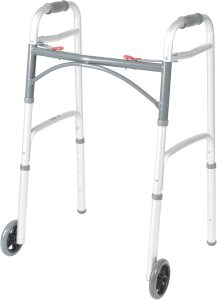
Two-wheel (front-wheeled) walker. Wheels on the front legs, tips or glides on the back. You push it forward instead of lifting it, so walking is smoother and more natural, and the back legs still give it some grip. For many seniors this is the everyday sweet spot.
Three- and four-wheel walkers (rollators). Wheels on every leg, hand brakes, and usually a seat on the four-wheel models. They’re the easiest to move but the least stable for leaning on, since nothing stops them except the brakes. More on that in Walker vs. Rollator below.
Specialty walkers. Hemi-walkers are used with one hand, often after a stroke. Bariatric walkers are built heavier for higher weight capacities. Your therapist will tell you if you need one of these.
Getting the height right
Stand up straight with your arms hanging relaxed. The handgrips should line up with the crease of your wrist. When you hold the grips, your elbows should bend slightly, about 15 to 20 degrees. Too low and you’ll hunch over; too high and your shoulders will ache. Most walkers adjust with push-button legs in 1-inch steps.
#ad · View Standard Walkers
🎾 Ski Glides vs. Tennis Balls
On a two-wheel walker, the back legs drag along the floor as you push. Something on those legs needs to slide smoothly without being slippery. Here are the two common choices:
Tennis balls. Cheap, quiet and kind to floors, which is why you see them everywhere. But they wear through fast on concrete and asphalt, pick up dirt, hair and gravel, and get flat spots that make the walker drag or wobble. Pre-cut walker balls are tidier than cutting your own.
Ski glides. Hard plastic sleds that snap over the back legs. They slide smoother, last much longer, and handle sidewalks better. They’re a few dollars more and a little noisier on hard floors. For anyone who walks outside, glides are usually the better buy.
One important rule: a standard walker with no wheels is designed to be lifted, and its rubber tips are what keep it from sliding. Don’t put glides or balls on all four legs unless your therapist tells you to.
#ad · View walker ski glides · View pre-cut walker balls · View replacement rubber tips
🧺 Baskets, Bags and Trays
Your hands are on the walker, so carrying anything gets tricky. A carrier is one of the most useful add-ons there is.
Baskets clip to the front crossbar and hold mail, groceries and a water bottle. Wire baskets are sturdy; check that it doesn’t hit your knees.
Bags and side pouches hang from the frame and keep a phone, glasses and keys within reach. Many fold with the walker, so you don’t have to remove them to get in the car.
Trays sit across the top so you can carry a plate or coffee from the kitchen. Look for one with a raised edge and cup holders.
Keep the load light, a few pounds at most, and centered. A heavy bag on the front can tip a lightweight walker forward.
#ad · View walker baskets · View walker bags · View walker trays
🆚 Walker vs. Rollator: Which Is Right?
Choose a walker (standard or two-wheel) if you need to put real weight on it, your balance is poor, or you’re recovering from surgery. It stays put when you lean on it.
Choose a rollator if you walk fairly steadily but tire out or need balance help over longer distances. It rolls with your stride, the seat lets you rest anywhere, and the brakes let you stop. You need enough hand strength to work the brakes, though, and it can roll away if you lean on it hard.
Plenty of people use both: a walker around the house and a rollator for errands and longer outings. For the full rollator rundown, see Rollators for Adults: What to Know Before You Buy.
💳 Does Medicare or Insurance Cover a Walker?
Yes, usually. Medicare Part B covers walkers as durable medical equipment (DME) when your doctor orders one for use in your home. After you meet your Part B deductible, you typically pay 20% of the Medicare-approved amount. The walker has to come from a supplier enrolled in Medicare, and it’s best to use one that “accepts assignment,” which means they agree to Medicare’s price.
Medicare Advantage plans must cover walkers too, but they may require you to use a supplier in their network or get approval first. Medicaid and many private plans cover walkers as well. Call the number on your card before you buy.
Accessories are a different story. Baskets, bags, trays and tennis balls are usually considered convenience items and aren’t covered. Since a basic walker isn’t expensive, some people simply buy one outright to skip the paperwork. Just know you can’t get Medicare to reimburse you later for a walker bought without the order and an enrolled supplier.
More detail: Warranty, Medicare & Financial Aid Guide.
💲 Medicare deductible and coinsurance amounts change every year. Confirm current figures and your supplier’s pricing at Medicare.gov or with your plan before you buy.
🔧 A Repair Tech’s Safety Check
Walkers look simple, but worn parts cause falls. Check these once a month:
- Rubber tips. If the tread is worn smooth or you can see metal, replace them now. Worn tips slip on tile and wet floors.
- Push-button locks. Every button should pop all the way through its hole with a click. A half-seated button can let a leg collapse.
- All legs the same height. Count the holes on each leg. One leg set a notch off makes the walker rock.
- Wobble. Push down on the frame. Loose rivets or a cracked weld mean it’s time for a new walker, not a repair.
- Wheels. They should spin freely with no flat spots or wobble, and nothing wrapped around the axle.
Walker FAQ
Is a walker with wheels better than one without?
Not always. Wheels make walking smoother and easier on the arms, but a walker without wheels is more stable when you need to lean on it. Many people start with a standard walker after surgery and move to a two-wheel walker as they get stronger.
Are ski glides better than tennis balls?
For most people, yes. Glides slide smoother, last much longer and don’t pick up dirt. Tennis balls are cheaper and quieter indoors but wear out quickly on sidewalks.
How do I know the walker is the right height?
Stand straight with your arms relaxed at your sides. The handgrips should be level with the crease of your wrist, and your elbows should bend slightly when you hold them.
Will Medicare pay for a walker?
Usually, yes. Medicare Part B covers walkers as durable medical equipment with your doctor’s order and a Medicare-enrolled supplier. You typically pay 20% of the approved amount after your Part B deductible. Accessories like baskets and glides usually aren’t covered.
Should I get a walker or a rollator?
A walker is better if you need to lean on it or your balance is poor. A rollator is better if you walk fairly steadily but need rest stops and balance help on longer outings. Your doctor or physical therapist can help you decide.
As an Amazon Associate I earn from qualifying purchases.