

Buy The Best Vehicle Scooter & Wheelchair Lift Techs Like
Hitch-mounted lifts and carriers for transporting a mobility scooter or power wheelchair on your vehicle. The right choice depends entirely on your vehicle’s actual hitch rating and your mobility device’s real weight and footprint — not just the vehicle type. Techs like it, works great, good price & support. Before Buying – FAQs
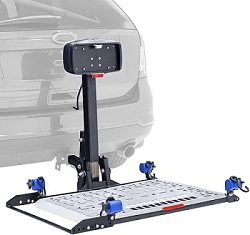
Silver Spring Universal Electric Wheelchair & Scooter Lift
#ad – A powered platform lift designed for Class III or IV 2″ hitch receivers (a Class II 1¼″ adapter is included), rated for wheelbases up to 42″ long x 27″ wide and up to 350 lbs. Owners generally praise the USA-made aluminum construction, straightforward no-drilling installation, and the fact that it folds up vertically to preserve rear visibility when not in use. A recurring critique on this style of lift is that the retractor straps can be spaced too far apart and too short for wider power chairs, and without protective contact points on the platform’s underside, a fully loaded platform can occasionally scrape on steep driveways or deep bumps — worth checking your specific chair’s tie-down points and your vehicle’s departure angle before assuming a perfect fit. We techs like this electric lift, the price is right, works great, the company support is good too!
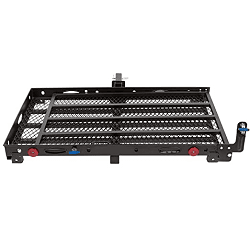
Silver Spring Steel Folding Scooter & Wheelchair Carrier & Ramp
#ad – A manual ramp-style carrier for Class III or IV 2″ hitch receivers, with a 500 lb weight capacity, anti-rattle device, and 5/8″ hitch pin. Reviews are genuinely mixed for this style of ramp carrier: many owners report exactly what it’s built for — an easy, affordable way to load and transport a scooter without a powered lift. But there’s a real recurring complaint about the platform sagging or leaning unevenly on some vehicles, particularly larger SUVs and trucks with more ground clearance, to the point of dragging on pavement over bumps. This appears tied to how level the platform sits relative to the vehicle’s hitch height — worth confirming your vehicle’s specific hitch height against the carrier’s ground clearance before ordering, especially if you drive a taller vehicle. Same as the electric, techs like it, simple – gets the job done, the price is right, good company support!
💲 Prices, availability, and specific model configurations change on Amazon over time. Always confirm your vehicle’s actual hitch class and weight rating, and your mobility device’s exact weight and dimensions, before purchasing.
⚠️ Important: Read Before You Buy a Vehicle Lift or Carrier
Two different numbers matter, and confusing them is the most common mistake: a lift’s “lifting capacity” (how much weight the lift itself can raise) is not the same thing as your vehicle’s hitch “weight capacity” or tongue weight rating (how much weight your hitch can actually support). A lift rated to lift 500 lbs attached to a smaller hitch rated for only 350 lbs can damage your vehicle and create a genuinely dangerous driving situation — both numbers have to work for your specific setup, not just one.
Never use a hitch-size adapter to make a bigger lift fit a smaller hitch. A 1¼″-to-2″ adapter lets a larger carrier physically plug into a smaller receiver, but it does not change what that smaller hitch is actually rated to support. This is a well-documented cause of hitch damage, carrier failure, and accidents — match the lift to your hitch’s real class rating, not just what physically fits.
Confirm your actual hitch class before shopping — check the manufacturer’s label on the hitch itself, or have a automobile dealer verify it. Don’t assume based on vehicle type; two vehicles that look similar can have different hitch classes.
When in doubt, talk to your vehicles local dealer or installer. They can confirm what will actually work — and be safe — for your specific vehicle, hitch, and mobility device before you spend money on something that doesn’t fit or isn’t rated correctly. More FAQs
Frequently Asked Questions
What’s the difference between a hitch class rating and a lift’s “lifting capacity”?
A lift’s “lifting capacity” is how much weight the lift mechanism itself is built to raise — it doesn’t account for how the lift is attached to your vehicle. Your vehicle’s hitch “weight capacity” (or tongue weight rating) is a completely separate number: how much downward weight your specific hitch can safely support. Both have to work together — a lift with a 500 lb lifting capacity attached to a Class II hitch (rated for only 350 lbs) risks damaging your vehicle even though the lift itself could technically handle the load.
How do I find out what hitch class my vehicle actually has?
Check the manufacturer’s label directly on the hitch itself — it will state the class and weight ratings. If the label is worn or missing, you can measure the receiver opening: 1¼″ openings are typically Class I or II, while 2″ openings are typically Class III, IV, or V. When in doubt, a dealer or hitch installer can confirm your exact rating in a few minutes.
Can I use a hitch adapter to fit a bigger lift onto a smaller hitch?
This is not recommended, and it’s a genuinely common cause of accidents and equipment damage. An adapter (for example, 1¼″ to 2″) lets a larger carrier physically plug into a smaller receiver, but it does not change what that smaller hitch is actually rated to support. The hitch itself — not just the adapter — has to be rated for the combined weight of the lift and your mobility device.
What’s the difference between a manual ramp carrier and a powered lift?
A manual ramp carrier requires you (or a caregiver) to physically drive or push the empty scooter up a ramp onto the platform — it’s generally more affordable and has fewer moving parts to maintain. A powered lift uses a motor, operated by a key or switch, to raise the scooter automatically once it’s secured on the platform at ground level — easier physically, but heavier and more expensive, and it depends on your vehicle’s electrical system.
Will an exterior hitch-mounted carrier expose my scooter to weather damage?
Yes, to some degree — the electronics in scooters and power wheelchairs are sensitive to rain, snow, and road spray, and an exterior carrier offers no real protection from the elements during transport. Weatherproof covers help block direct rain but won’t stop splash-up from underneath. If you live somewhere with harsh winters or frequent storms, an interior lift or enclosed trailer is a more reliable long-term option than an exterior hitch-mounted carrier.
What should I know about my vehicle’s ground clearance before buying a carrier?
A loaded carrier hanging off the back of your vehicle can drag or scrape over driveway inclines, speed bumps, or steep entrances if it sits too low relative to your hitch height. This is a genuinely common complaint, especially on lower vehicles or when using a longer hitch adapter that pushes the platform further back and down. Measuring your vehicle’s actual departure angle and the carrier’s ground clearance before buying avoids a frustrating (and sometimes damaging) surprise.
What if my vehicle doesn’t have a hitch rated high enough for the lift I need?
A few options exist: some vehicles can have a higher-rated hitch installed by a professional, though this isn’t possible on every vehicle. If upgrading the hitch isn’t an option, a small towable trailer is a legitimate alternative that doesn’t rely on your vehicle’s hitch weight rating in the same way — you can browse trailer options here: shop small cargo trailers.
What’s “bumper distance” and why does it matter when choosing a hitch adapter?
Bumper distance is the measurement from your hitch’s bolt hole to the rear-most point of your vehicle. It determines which length adapter you need: shorter distances (roughly 0-7.5″) generally call for a short adapter, mid-range distances (7.5-10″) call for a standard adapter, and longer distances (10-13.5″) call for an extra-long adapter. Getting this wrong can leave the lift or carrier sticking out further than expected, or sitting at an awkward angle that affects ground clearance.
Does the wiring harness for lights actually matter?
Yes — a hitch-mounted carrier often extends past your vehicle’s tail lights and license plate, which is why most quality lifts and carriers include a wiring harness and a license plate holder. This isn’t just a convenience feature; covering your plate or tail lights without a proper harness and holder can be a legal violation in most states, in addition to being a real visibility and safety issue for other drivers.
What’s actually new in vehicle lift technology?
The genuinely real recent improvements are practical: soft-start lift motors that raise the scooter more gently, overload protection that shuts the motor down before it burns out, anti-theft power locks, LED work lighting to help with loading in the dark, and quick-charge removable lithium battery options for powered lifts as an alternative to hardwiring into your vehicle’s electrical system. Broader marketing claims about “AI-powered” lifts that predict user behavior, or integration with self-driving vehicles, remain speculative concepts rather than something available to buy today.
Should I buy a lift or carrier online, or have it professionally installed?
Buying online is common and often more affordable, but installation and compatibility verification are where it’s worth getting professional input. A local dealer or hitch installer can confirm your hitch class, check your mobility device’s actual weight and footprint against the lift’s ratings, and install the wiring harness correctly — all things that are much easier to get right in person than to guess at from a product listing.
What’s the real difference between the Silver Spring lift and the Silver Spring carrier and ramp?
The lift is powered — you secure your scooter on the platform at ground level and a motor raises it into transport position, which is easier physically but adds weight, cost, and a wiring dependency. The ramp carrier is manual — you drive or push the empty scooter up a ramp yourself, which is more affordable and has fewer moving parts, but requires more physical effort and a clear ramp angle to work with.
Can I use a carrier rated for one type of mobility device for a heavier power wheelchair?
Not automatically — confirm both the actual weight and the physical footprint (wheelbase length and width) of your specific device against the carrier’s stated limits, not just its general “wheelchair carrier” label. Power wheelchairs are often heavier and have different tie-down points than manual wheelchairs or scooters, so a carrier that works well for one may not securely fit or safely support the other.
What’s the biggest overall mistake people make buying a vehicle lift or carrier online?
Buying based on weight capacity or price alone, without separately confirming: (1) that the vehicle’s actual hitch class matches what the lift requires, (2) that the lift’s true lifting capacity and the hitch’s tongue weight rating both cover the combined weight of the lift plus the mobility device, and (3) that the device’s specific wheelbase and tie-down points actually fit the platform. Missing any one of these is how people end up with equipment that doesn’t fit, doesn’t work safely, or has to be returned.
As an Amazon Associate I earn from qualifying purchases.