

Bath & Shower Aids: What to Check Before You Buy
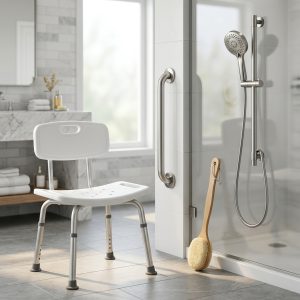
What Bath & Shower Aids Do Seniors Actually Need?
#ad · The bathroom is where most falls at home happen. The right aid depends on the problem: standing too long, stepping over the tub wall, or slippery floors. Here’s how to match the aid to the need, what to look for, and what Medicare will and won’t pay for.
🛁 Which Bath or Shower Aid Do You Need?
Can’t stand long in the shower? A shower chair (or a stool for tight stalls) lets you sit while you wash. Choose one with a backrest and arms if balance is a concern.
Hard to step over the tub wall? A tub transfer bench straddles the tub edge: you sit down outside the tub, then slide across, so you never have to lift your legs over the wall while standing. For people who can’t get down to the tub floor at all, a powered bath lift lowers you into the water and raises you back up.
Need something to hold onto? Grab bars screwed into the wall studs give solid support when stepping in, sitting down, and standing up. A clamp-on tub rail attaches to the tub wall without tools and gives a handhold right where you step over.
Slippery floor? A non-slip mat inside the tub or shower, and a rubber-backed rug outside it, are the cheapest fall protection there is.
Trouble reaching or rinsing? A handheld showerhead on a hose lets you shower seated and direct the water where you need it. A long-handled sponge helps with feet and back.
✅ What to Look For When Choosing One
Weight capacity with real margin above the user’s weight. Standard shower chairs hold about 250–300 lbs; heavy-duty (bariatric) models go to 400 lbs or more.
Adjustable height. With the user seated, feet should rest flat on the floor with knees at about a right angle. Legs that adjust in 1-inch steps make that easy to get right.
Non-slip rubber feet and rust-proof aluminum. Check that the tips are rubber, not hard plastic, and that the frame won’t rust from daily use.
Measure before you buy. For a transfer bench, measure the tub’s width and wall height. For a clamp-on rail, measure the tub wall’s thickness and check that the listing covers it; these don’t fit fiberglass or tile-topped tubs well.
Grab bars must go into studs or use proper wall anchors rated for the load. If you’re not sure what’s behind the tile, have a handyman install them.
Backrest and arms on a shower chair cost a little more but make sitting down and standing up much safer for anyone with weak legs or poor balance.
💳 Does Medicare Cover Bath & Shower Aids?
Generally, no. Original Medicare treats shower chairs, transfer benches, grab bars, and bath mats as personal comfort or convenience items rather than durable medical equipment, so it usually doesn’t pay for them, even with a prescription.
Where you may get help: some Medicare Advantage plans include bathroom safety items as a supplemental benefit or through an over-the-counter allowance. Your state’s Medicaid waiver programs, the local Area Agency on Aging, and the VA (for veterans) may also help. Bath safety equipment is often eligible for HSA/FSA funds. One exception to know about: a bedside commode can be covered by Medicare when you’re confined to a bedroom, and some commodes also work as a shower chair.
#ad · View the most popular bath & shower aids
💲 Coverage, plan benefits, and prices change. Confirm with your Medicare Advantage plan or Medicare.gov before you buy, and check current pricing on Amazon.
🏠 Quick Bathroom Safety Checklist
• Put a night light between the bedroom and bathroom.
• Keep the water heater at 120°F or below to prevent scalding.
• Skip bath oils, which make the tub floor slick.
• Keep soap, shampoo, and towels within reach of where you sit.
• Don’t use towel bars or soap dishes as handholds; they aren’t built to hold your weight.
#ad · Shop popular shower chairs, transfer benches & grab bars
Frequently Asked Questions
What’s the difference between a shower chair and a tub transfer bench?
A shower chair sits entirely inside the tub or shower. A transfer bench is longer and straddles the tub wall, with two legs inside and two outside, so you can sit down outside the tub and slide across instead of stepping over the wall.
Are suction-cup grab bars safe?
Use them only for balance, never to hold your full weight. Suction can let go without warning, so check the suction indicators before every use. For real support, use grab bars screwed into the wall studs.
What height should a shower chair be?
With the user seated, their feet should be flat on the floor with knees at about a right angle. Most shower chairs adjust from about 16 to 21 inches.
Can I install grab bars myself?
Yes, if you can find the wall studs and drill through tile. The bar has to be anchored into studs or rated wall anchors to hold your weight. If you’re unsure, a handyman can do it in an hour or two.
Will Medicare pay for a shower chair?
Usually not. Original Medicare considers it a convenience item. Some Medicare Advantage plans cover bathroom safety items, and a bedside commode that doubles as a shower chair may be covered if you’re confined to your room.
As an Amazon Associate I earn from qualifying purchases.