

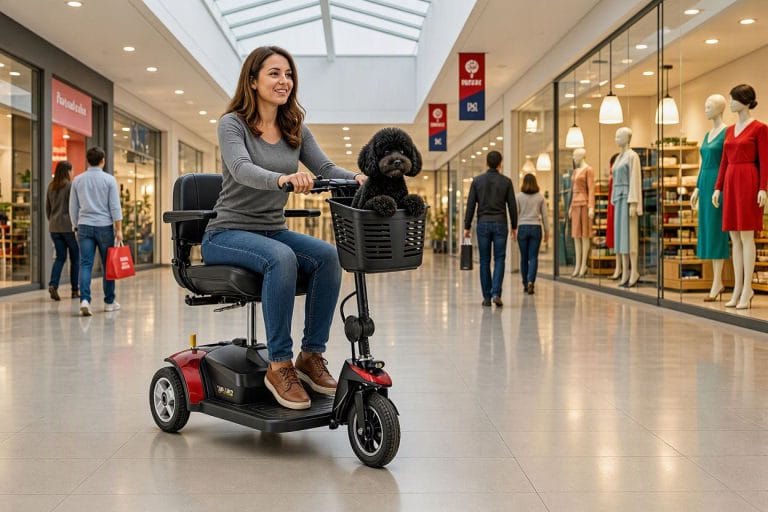
Go-Go Elite Traveller (Model: SC442E – 12AH – 4 Wheel)
#ad – Owner reviews for this model consistently land around 4.6–4.7 stars, with the most common praise being how easy it is to take apart for the car and how stable it feels on sidewalks and grass. The one recurring complaint is a slow, creeping start from a stop before it builds up to normal speed — several long-time owners mention getting used to it after the first few rides.
🚗 Real-World Transport
The auto-latching frame separates easily with one hand, and the heaviest piece is only about 34 lbs — manageable for most active seniors to lift into a standard sedan trunk.
⚖️ Stability vs. Agility
The 4-wheel design gives noticeably better stability on outdoor sidewalks and uneven cracks compared to the 3-wheel version, but the 44-inch turning radius may mean a 3-point turn in very tight apartment hallways.
🔌 Smart Charging
The tiller-mounted charging port lets you plug the charger directly into the handlebars — no bending over required.
🔋 Battery & Range
The standard 12AH battery pack is lighter for transport; for full-day outings, an 18AH battery upgrade extends the range.
Go-Go Elite Traveller (Model: SC40E – 3 Wheel)
#ad – This is one of the most consistently praised models in the lineup, regularly cited for its tight turning radius in apartments, senior living communities, and public restrooms. The few complaints that come up are minor — some riders note the ground clearance is on the low side and wish Pride offered a lithium battery option.
🔄 Indoor Agility
The tight turning radius makes this easier to maneuver in narrow apartment hallways or grocery aisles where the 4-wheel version might need a 3-point turn.
🦵 Extra Legroom
With no front wheel wells in the way, the 3-wheel layout gives noticeably more legroom — a real plus for taller riders or anyone with stiff knees.
🤚 Straight Handlebars
This model uses standard straight handlebars rather than a wraparound “delta” tiller. Fine with good grip strength; those with hand arthritis may prefer a delta-style tiller on other models.
🧳 Easy Transport
Breaks down into 5 lightweight pieces quickly, with a manageable heaviest piece — no vehicle lift needed for a standard sedan trunk.
Go-Go Sport (Model: S74 – 4 Wheel)
#ad – Reviewers regularly single out the 325 lb weight capacity and stability as reasons they chose this over the standard Elite Traveller, and the newer EZ Turn version gets specific praise for combining a tighter turning radius with 4-wheel stability. It’s a heavier scooter to break down than the Traveller line, so a few reviewers mention wanting a second person to help lift the base piece.
💪 Heavy-Duty Stability
The reinforced frame handles up to 325 lbs, and the longer wheelbase feels noticeably less “tippy” for taller or heavier riders than the standard travel scooters.
🌿 Outdoor Terrain
Slightly larger tires give about 3 inches of ground clearance — enough to handle park grass or rougher asphalt without bottoming out.
🔋 Battery Power
Comes standard with 18AH batteries, which the higher 4.7 mph top speed needs to avoid draining power halfway through the day.
💡 Comfort & Safety
A longer deck adds legroom for bigger riders, and a standard front LED headlight is a genuine safety plus for after-dusk use.
Pride Mobility Go-Go Sport (Model: S73 – 3 Wheel)
#ad – Owners consistently highlight the long battery range and easy 5-piece disassembly, with several noting they’ve stuck with this model specifically for the combination of legroom and portability. As with other 3-wheel scooters, a handful of reviews mention it feels less planted on uneven or sloped ground than the 4-wheel version.
🦵 Maximum Legroom
The extended “Sport” deck combined with the open 3-wheel front design offers the most legroom in the travel lineup — notable for riders over 6 feet tall or with stiff knees.
🔄 Heavy-Duty Agility
Carries the full 325 lb weight capacity of the Sport series with a tight 36-inch turning radius — legitimately maneuverable in tight home corners or cruise ship corridors.
⚠️ Stability Trade-off
Sitting higher on 3 wheels makes it less stable on side-slopes than the 4-wheel version. Best suited to flat paved surfaces or indoor use rather than uneven backyard grass.
💡 Lighting & Range
Standard 18AH batteries and a bright front LED headlight mean up to 12+ miles of range without sacrificing the tighter turning radius.
💲 Prices, availability, and specific model configurations change on Amazon over time. Confirm current pricing and specs on the product page before purchasing.
If Your Last Scooter Let You Down, You’re Not Alone
A lot of people land on this page after a bad first experience with a scooter — and it’s usually not the battery. The complaints we hear most from techs and owners who switched brands:
- No parts or service support once something breaks
- Couldn’t find a local tech who actually knew the model
- No real repair manual to work from — techs were guessing
- Died early from bad electrical connections
- Throttle broke
- Freewheel lever broke
- Frame or parts fell apart or rusted within a year or two
None of that is normal wear and tear — that’s a scooter that wasn’t built to last, or a brand that doesn’t stand behind it once you’ve bought it. It’s exactly why Pride’s Go-Go line ends up being the one techs point people toward.
🔧 Real Manuals, Real Parts
Techs aren’t guessing at wiring diagrams or reverse-engineering a controller — the documentation exists, and common failure points like throttles, freewheel levers, and connectors are actually stocked, not a special-order part that takes weeks.
🛠️ A Real Support Network
Pride’s been in this business long enough that dealers, techs, and parts suppliers across the country already know these scooters — you’re not stuck finding the one person in the state who’s seen this model before.
That matters more than most first-time buyers realize — until the day something breaks and they find out whether their scooter’s brand actually backs it up.
👍 Why Owners Keep Coming Back to Go-Go, After Trying Other Brands
It’s common to talk to a Go-Go owner who’s on their second or third scooter — and the first one wasn’t a Pride. The pattern we hear over and over: the first scooter looked fine on paper, seemed like a good deal, and then within a year or two something failed that shouldn’t have — a connection went bad, a lever snapped, the frame started rusting — and there was nowhere to turn for a fix.
Go-Go owners consistently report the opposite experience: years of daily use without the frame, throttle, or controller giving out, and when something eventually does need attention, an actual path to get it fixed.
You’ve Probably Already Seen Them
Next time you’re at Disney, a casino, a mall, or any busy public destination — take a look at the mobility scooters people are actually riding. You’ll see Go-Go and Pride models everywhere. That’s not a coincidence. Venues that rent scooters all day, every day, to thousands of different riders need equipment that holds up to real abuse without constant breakdowns — and Pride is what they keep buying.
Which Go-Go Model? Elite Traveller vs. Sport
Both the Go-Go Elite Traveller and Go-Go Sport are excellent, genuinely popular scooters — the difference between them comes down to personal preference more than one being “better.” Some riders prioritize the lightest possible transport; others prefer the extra weight capacity and stability of the Sport line. Here’s what sets them apart, and four specific models within each line.
Frequently Asked Questions
What should I actually look for before buying a mobility scooter?
Skip anything without a real parts and service network behind it — that’s the single biggest predictor of regret. Ask specifically: can a local tech get a repair manual for this model? Are replacement parts like the throttle, freewheel lever, and connectors actually in stock somewhere, or special-order only? A scooter that looks identical on a spec sheet can be a completely different ownership experience once something needs fixing. Measure & size a scooter – Insurance questions?
What’s the difference between the Go-Go Elite Traveller and Go-Go Sport?
Both are excellent, genuinely popular models — the difference comes down to personal preference rather than one being better. The Elite Traveller line is built specifically for portability — lighter overall weight, designed to break down into pieces manageable for one person to lift into a car. The Sport line trades some of that portability for a higher 325 lb weight capacity, a reinforced frame, and better ground clearance, making it the better fit for larger riders or slightly rougher terrain.
What conditions typically call for a mobility scooter?
Arthritis, osteoporosis, and other age-related joint conditions are common reasons, along with chronic conditions like heart or lung disease that make extended walking difficult. Injuries (broken bones, spinal cord injuries, amputations) and disabilities such as cerebral palsy, muscular dystrophy, or multiple sclerosis are other common reasons people switch to a scooter rather than relying on a cane or walker alone.
What are the real benefits of switching to a mobility scooter?
The most consistent benefits reported are increased independence for errands and social visits, reduced fatigue and pain from standing or walking long distances, and improved safety — a scooter’s lower center of gravity makes it more stable than trying to walk unsupported, and features like headlights genuinely help with visibility after dark.
What’s the difference between portable, heavy-duty, and all-terrain scooters?
Portable scooters (like the Go-Go Elite Traveller models above) are lightweight and designed to break down for car trunk transport. Heavy-duty scooters (like the Go-Go Sport line) carry higher weight capacities with reinforced frames, at some cost to portability. All-terrain and off-road scooters use larger tires and more ground clearance for grass, gravel, or uneven paths — a different category from either travel or heavy-duty models, and usually not something you fold into a sedan trunk.
How do I choose the right mobility scooter for my needs?
Start with how you’ll actually use it day to day: mostly indoor and around town favors a compact, tight-turning model; frequent travel favors a lightweight foldable design; larger riders or rougher terrain favor a heavy-duty or all-terrain model. Weight capacity, your typical trip distance (which drives battery size), and how often you’ll need to lift or transport it are the three factors worth weighing before anything else. Measure & size a scooter
What’s actually new in mobility scooter technology?
The most meaningful recent changes are practical rather than flashy: lithium-ion battery options that are lighter and charge faster than traditional lead-acid batteries, improved folding mechanisms that make travel scooters genuinely easier to load without help, and more widespread LED lighting and anti-tip wheel designs as standard safety features. Claims about fully self-driving or 3D-printed consumer scooters are largely speculative marketing rather than something currently available to buy.
What should I know before buying a mobility scooter?
Cost is the biggest factor — not all insurance covers the full price, and out-of-pocket costs vary widely by model. Scooters also need regular maintenance (battery care especially), have a hard weight limit that shouldn’t be exceeded for safety, and most are built for smooth, dry surfaces rather than rain or rough terrain. If cognitive or vision changes are a factor, that’s worth discussing with a doctor or occupational therapist before choosing a model. Measure & size a scooter – Insurance questions?
Should I get the 3-wheel or 4-wheel version?
3-wheel models turn in a noticeably tighter radius, which matters most for indoor use, apartment hallways, and tight spaces like cruise ship corridors. 4-wheel models are more stable on outdoor sidewalks, cracks, and uneven pavement, at the cost of needing more room to turn around. If most of your use is indoors or in tight spaces, lean 3-wheel; if most of your use is outdoors on real-world sidewalks, lean 4-wheel. Measure & size a scooter
How much does a travel scooter weigh when broken down?
For the models above, the heaviest single piece after breaking the scooter down runs around 34 lbs — manageable for most active adults to lift into a car trunk without help, though anyone with shoulder or back limitations should have a second person available just in case.
Can I take a travel mobility scooter on an airplane?
Often yes, but airline rules for lithium battery mobility devices are more permissive than the rules for recreational items like hoverboards, and specific watt-hour limits vary by airline rather than being one universal number. Always confirm directly with your specific airline before booking — including whether the battery must be removed and carried separately — rather than relying on a general rule found online.
What’s a realistic turning radius for indoor use?
Among the models compared here, the 3-wheel scooters turn in roughly a 36-inch radius versus about 44 inches for the 4-wheel Elite Traveller. As a rule of thumb, anything in the mid-30s to low-40s (inches) handles most standard hallways and doorways reasonably well — measuring your own tightest hallway or doorway before buying is still the most reliable way to avoid a bad fit.
How do I measure & size a scooter?
Measurements are critical for everyday scooter users. Use this guide In order to have a comfortable and functional piece of equipment which will meet all their needs and provide for the best possible results. Measure & size a scooter
Can these scooter batteries be converted to lithium?
Most SLA / AGM scooter batteries can be substituted for lithium batteries, but a different charger will be needed normally, and the charge meter on the scooter will normally not give you an accurate reading due to the different holding charge behavior of lithium vs SLA / AGM batteries. read more
What’s the difference between mobility scooters & Power Wheelchairs?
Typically scooters are for people with less serious mobility issues. Power wheelchair (also named power chairs, electric wheelchairs) users may need better control in tight areas, and could be sitting in the chair for longer periods. Measure & size a scooter
As an Amazon Associate I earn from qualifying purchases.