

What Are the Top-Selling Power Chairs — And Why?
Four of the top power chairs compared side by side — from a rear-wheel-drive chair that breaks into carry-friendly pieces to a true mid-wheel-drive chair built for all-day comfort. Here’s what actually sets each one apart, and why techs and owners like them.
Golden Technologies LiteRider Envy Compact Power Chair
#ad – Owner reviews run around 4.5 stars, with the most consistent praise being how easy it is to load and unload independently — several long-term owners specifically mention choosing this over folding chairs because one person can manage it alone. The recurring gripe is smaller stuff: an occasional seat-latch that needs re-securing, and a couple of owners noting the included tool kit was missing an Allen wrench size needed for assembly.
🧺 Unique Storage Design
Comes standard with two storage baskets (one under the seat) — a real convenience for chargers or a purse without needing aftermarket bags.
🧰 Disassembly & Transport
Breaks down into 4 manageable pieces; the heaviest part is about 37 lbs, comparable to a travel scooter, with the all-day comfort of a stadium-style power chair seat.
⚙️ Rear-Wheel Drive Feel
A Rear-Wheel Drive (RWD) unit — feels very stable outdoors, but has a larger 28.5-inch turning radius than a mid-wheel drive Jazzy, so corners need a bit more room in tight hallways.
🔋 Battery Access
The 22AH battery pack lifts right out for off-board charging — leave the chair in the trunk and just bring the battery pack inside to charge.
Technician’s Note: Techs like this LiteRider Envy just as much as the Pride GO Chair (I consider them both #1). The reason is simple: they are well-built, and we can always get parts and support for them. That peace of mind is worth everything.
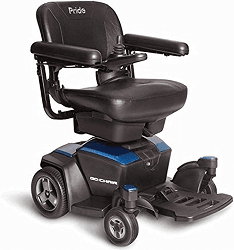
GO CHAIR Pride Mobility Travel Electric Power Chair
#ad – This model holds a strong 4.4–4.5 stars across dozens of reviews, with owners repeatedly praising how easily it turns and threads through doorways and tight spaces. The most common complaint is the fixed, non-adjustable seat — several reviewers found it firm and added their own cushion — and a handful mention the anti-tip wheels catching on curb transitions or thresholds.
🔄 Tight Quarters Agility
A 25.4-inch turning radius is significantly tighter than the Golden LiteRider — navigate around kitchen islands and bathroom doors with much less backing up.
✋ One-Hand Disassembly
Pride’s “Feather-Touch” latch system separates the rear motor section with one hand; the heaviest piece is only 36 lbs, manageable for car transport.
🧺 Smart Storage
Swing-out storage bins hidden under the seat, instead of a bulky front basket that bangs into walls — keeps the chair compact with room for a phone and keys.
🍽️ Table Access
The swivel seat rotates easily — drive right up to a restaurant table and exit without scooting the chair backward first.
Technician’s Note: This is the “Sports Car” of the travel power chair world—small, tight, and quick.
Pride Mobility Jazzy Carbon Travel Folding Power Chair
#ad – Reviews average 4.6 stars, with owners consistently highlighting the independence it gave them while traveling — several specifically mention using it for trips where their regular chair wasn’t practical. The main complaint is joystick sensitivity: a few owners describe it as slow to respond and then abrupt when released, and at least one reviewer found the 43-lb single-piece lift genuinely too heavy to manage alone.
🪶 Carbon Fiber Advantage
The “Airport King.” Because the frame is carbon fiber, it’s incredibly strong but weighs significantly less than standard steel chairs, and folds in seconds like a stroller — ideal for checking at the jetway.
⚠️ Lifting Reality
It’s light (about 43 lbs total), but it does not break into smaller pieces like the Go Chair — you lift the entire folded unit at once. Fine if you can lift 40+ lbs; otherwise stick to a disassembling model.
✈️ Airline Compliant
The lithium-ion battery pops right out, exactly what the TSA requires — carry the battery on the plane while the chair goes in the cargo hold.
🪂 Ride Quality
The trade-off for being this light is you’ll feel bumps more. Smaller solid wheels are fantastic on smooth airport terminals and cruise ships, less so on gravel or rough cobblestones.
Pride Jazzy Select Power Chair
#ad – Owners rate this between 4.3 and 4.6 stars depending on retailer, with the mid-wheel drive’s tight turning radius drawing the most consistent praise for navigating doorways and corners. A few reviewers note the controller can feel oversensitive at slow speeds, and at least one mentioned no mounting brackets for tie-down anchors on facility transport buses.
🔄 True “Zero-Turn” Maneuverability
A Mid-Wheel Drive (MWD) unit — drive wheels sit dead center, letting it spin 360 degrees in its own footprint. For a tight kitchen or narrow hallways, this is the drive type worth prioritizing.
🪑 All-Day Comfort
A full-depth, high-back Captain’s Seat with a headrest, designed for sitting 4+ hours at a time — support that folding travel chairs can’t match.
🔋 Standard U1 Batteries
Runs on standard U1 lead-acid batteries, available at almost any auto or battery store for a fraction of the cost of proprietary lithium packs.
⚖️ 6-Wheel Stability
Active-Trac Suspension and 6 wheels always touching the ground make this significantly more stable than portable units — no “tippy” feeling crossing a threshold.
💲 Prices, availability, and specific model configurations change on Amazon over time. Confirm current pricing and specs on the product page before purchasing.
Frequently Asked Questions
What’s the difference between the Go Chair and the LiteRider Envy?
Both are well-regarded travel power chairs, but they differ in specifics: the Go Chair has a tighter 25.4-inch turning radius and a one-hand “Feather-Touch” latch system, while the LiteRider Envy is Rear-Wheel Drive with a slightly wider 28.5-inch turning radius and comes standard with two storage baskets. Both disassemble into similarly light pieces (36-37 lbs heaviest part) for solo transport.
Which of these travel chairs is easiest to lift alone?
The Go Chair and LiteRider Envy both edge out the Jazzy Carbon here, since they disassemble into smaller pieces (36 and 37 lbs heaviest part, respectively) rather than requiring you to lift one connected unit. The Jazzy Carbon is lighter overall at around 43 lbs, but that full weight comes as a single lift since it folds rather than disassembles.
What’s the difference between mid-wheel, rear-wheel, and front-wheel drive power wheelchairs?
Mid-wheel drive chairs (like the Jazzy Select) have drive wheels positioned dead center, allowing the tightest possible turning radius — the chair can essentially spin in its own footprint. Rear-wheel drive chairs (like the LiteRider Envy) tend to feel more stable at speed outdoors but need a wider turning radius. Front-wheel drive chairs climb curbs and obstacles well but can feel less predictable at higher speeds. The right choice depends on whether tight indoor maneuvering or outdoor stability matters more for daily use.
What are the real benefits of switching to a power wheelchair?
The most direct benefit over a manual wheelchair is reduced physical strain — operating a joystick instead of pushing wheels significantly cuts the upper-body fatigue and shoulder strain that manual wheelchair users commonly develop over time. Power wheelchairs also generally offer better postural support through contoured, cushioned seating built for extended daily use, which manual chairs and lightweight travel scooters typically don’t match.
How do I choose the right power wheelchair for my body type and daily needs?
Start with how many hours a day you’ll actually be seated in it: several hours daily points toward a full-comfort chair like the Jazzy Select with a captain’s seat, while occasional or travel use points toward a lighter, disassembling model. Weight capacity, seat width, and whether you need one-arm or specialized joystick controls are the next factors worth confirming directly against your own measurements — not just the chair’s general size class. Go To Measure & Size
What’s actually new in power wheelchair technology?
The most meaningful recent changes are practical: lithium-ion battery options that are lighter and charge faster than lead-acid, more compact motor designs that have made genuinely travel-friendly folding and disassembling chairs possible, and suspension systems (like Pride’s Active-Trac) that smooth out uneven terrain without adding bulk. Broader claims about AI-driven “smart wheelchairs” or assistive robots remain largely experimental rather than something available to buy today.
What should I know before buying a power wheelchair?
Cost is the biggest factor — power wheelchairs run more than manual chairs, and insurance doesn’t always cover the full price. Battery life is finite and worth checking against your actual daily distance, not just the advertised range. Most travel and compact power chairs are built for smooth indoor and paved surfaces rather than rough terrain, so confirm the terrain you’ll actually use it on before buying a lighter, less rugged model. Go To Measure & Size
Can I use standard batteries in my power wheelchair to save money?
Some power wheelchairs, like the Jazzy Select, run on standard U1 lead-acid batteries available at almost any auto or battery store — a real cost advantage over models locked into a specific proprietary lithium pack. If battery replacement cost matters to you long-term, it’s worth asking specifically whether a model uses a standard battery format before buying.
How much does a travel power chair weigh when broken down?
Among the models compared here, the heaviest single piece after disassembly runs from about 36 lbs (Go Chair) to 37 lbs (LiteRider Envy), while the Jazzy Carbon’s single-piece fold comes in around 43 lbs total since it doesn’t break apart. If lifting weight is your main concern, a disassembling design generally beats a folding one, even when the folding chair’s total weight is lower.
What’s a realistic turning radius for indoor use in a power wheelchair?
Among the models compared here, turning radius ranges from 22.5 inches (Jazzy Select, mid-wheel drive) up to 28.5 inches (LiteRider Envy, rear-wheel drive). Mid-wheel drive chairs consistently offer the tightest turns for navigating kitchens and hallways; if tight indoor spaces are your main use case, prioritize turning radius over other specs.
Can I take a power wheelchair on an airplane?
Often yes for lithium-battery models — both the Jazzy Carbon and similar lithium-powered travel chairs are marketed as airline-compliant — but rules vary by carrier and by whether the battery is lithium or lead-acid. Always confirm directly with your specific airline before booking, including whether the battery must be removed and carried separately from the chair.
Does a power wheelchair need to be disassembled to fit in a car, or can it just fold?
It depends on the model. Chairs like the Go Chair and LiteRider Envy separate into multiple smaller pieces, which is easier on the back per-lift but takes more steps. The Jazzy Carbon instead folds as a single unit like a stroller — fewer steps, but the entire folded weight has to be lifted at once. Which approach is better depends on whether you’re limited more by total lifting weight or by how many separate pieces you’re willing to handle.
How do I measure & size someone for a power wheelchair?
If this is your first power or electric wheelchair, sizing mistakes matter more here than almost anywhere else in mobility equipment — an ill-fitting chair isn’t just uncomfortable, it can affect circulation, posture, and how safely someone transfers in and out every single day. Go To Measure & Size
As an Amazon Associate I earn from qualifying purchases.